

Improving Academic Self-Navigation for Community College Students
Design Research, Service Design, UX/UI Design
August - December 2018
Introduction
Within a fifteen-week project that focused on social innovations for local communities, our team was tasked with identifying the broad challenges in the local community college student experience in effort to improve student-led navigation through their academic experience. The project resulted in a pilot proposal of custom interactive kiosks for student use and testing at the Los Angeles Trade Technical College.
“I know the information is there, but I don’t know where to find it.”
Rachel, 18, Community College Student
Objectives
Our project objectives were (1) to conduct generative research to identify existing challenges in the Community College student academic experience, and (2) to observe recurring student behaviors "between classes" on campus as potential points of leverage and/or support in problem-solving.
Research Questions
What are the habits and general behaviors of students on-campus?
What are the observed or expressed challenges facing students on-campus?
How might these learnings enable opportunities to improve student academic experiences?

Duration
Fifteen Weeks
Role
Design Researcher
UX/UI Designer
Team
Mashal Ali
Hamsini Balaji
Lisa Gordon-Cain
Liziane Dranka Silva
Vanessa Karkoutly
Stakeholders
Los Angeles Trade Technical College
Process
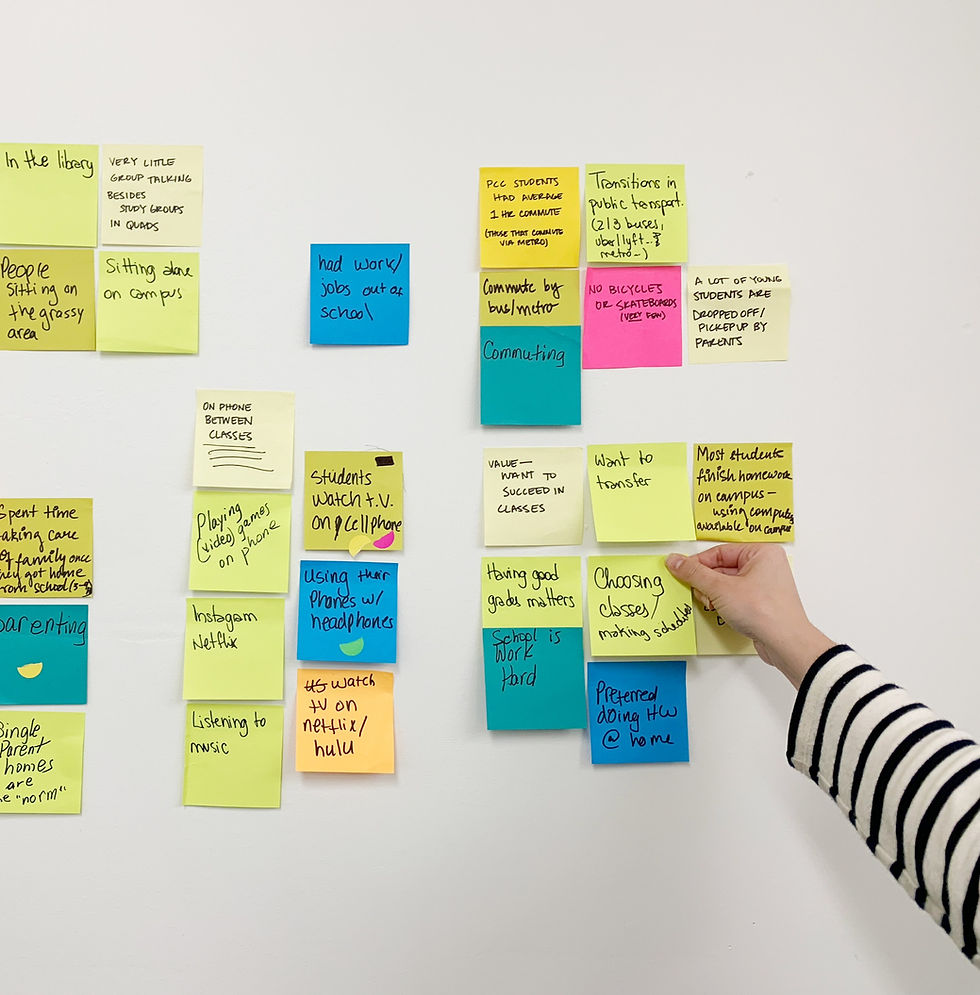
Our five-person team worked with local Community College faculty at over six Los Angeles area campuses to conduct observations, and lead over 125 qualitative interviews with students and college stakeholders (e.g., Academic Advisors, and Faculty).
Qualitative Interviews
125 qualitative in-depth interviews and field intercepts (with an estimated 25 interviews conducted by each team member)
Participatory Design Studies
"Day in the Life" interview drawings to extract qualitative insights


"Everything at this school is D.I.Y., and I don't have time for that... like meeting with an academic counselor"
Alan, 46, Community College Student
Focus Question and Opportunities
Our qualitative and subsequent quantitative survey research revealed that more than 50% of the interviewed students expressed feeling “overwhelmed” and “lost” in navigating their academic experiences, and 25% expressed having “difficulty” in choosing the right classes to meet their academic goals. Participants mentioned withdrawing from programs due to these feelings and challenges.
Our team down-selected our problem focus to “students feeling ‘directionless’ in navigating their academic experience,” and leveraged the observed student behavior of digital device usage during their “found time” on campus between classes to ideate solutions for the following opportunity statement:
How might we help local Community College students better self-navigate their academic experiences to prevent drop-out?
Design Constraints and Considerations
-
User-friendly, accessible, "non-threatening"
-
Adaptable for evolving student-centric needs and interests
-
Leverage existing student interests and assets
-
Low-maintenance, "non-disruptive," and supportive to Community College stakeholders needs and interests

Concept Proposal
As a potential solution, our team proposed custom digital interactive kiosks, strategically placed in high-traffic areas on campus, to assist currently enrolled community college students in accessing academic information needed relevant to successfully complete their community college experience. The kiosk content would prioritize and adapt navigation based on student needs, and would interlink multiple public resources and student platforms to enable immediate, user-friendly access, particularly to answers that would otherwise require cumbersome navigation, scheduling, and/or paperwork.
Proposed content features included a class schedule list, transfer information and requirements, single-touch meeting scheduling with Academic Counselors, and responses delivered through email for discretion (as identified through research); The proposed hardware features included resonant phone charging capabilities (in theory, not tested).

Deliverables
Our deliverables included a summary report of our generative research, insights, and ideation processes, a presentation overview of the proposed interactive digital kiosks to Los Angeles Trade Technical College stakeholders, and the preliminary UI/UX navigational priorities, as identified by research.

Reflections
This social impact course allowed me to expand my education and practices in design thinking, and encouraged mindfulness of the tethered communities of which the "end-user" is a part of, to ensure the support of their existing systems, rather than disrupt them.
Additionally, the project itself was a great exercise in generative design research, especially in administering large quantity interviews operations, and I am thankful for the opportunity to have collaborated with talented, interdisciplinary, and multi-generational women.
Lastly, though the project results were positively received by the our Community College stakeholders. In reflection, I would have liked to have documented our research process more to enable a better insight share with interested stakeholders, and to have independently moved forward with prototyping and testing to develop a more viable concept for impact.